The Palmoria Group is involved with problems that concerns gender inequality. Recently, the news with the headline “Palmoria, the Manufacturing Patriarchy” appeared in the media. Palmoria is interested in looking into options to address the concerns before they get out of hand, given the unfavorable public impression that this claim may cause the organization, especially with its current business development goals.
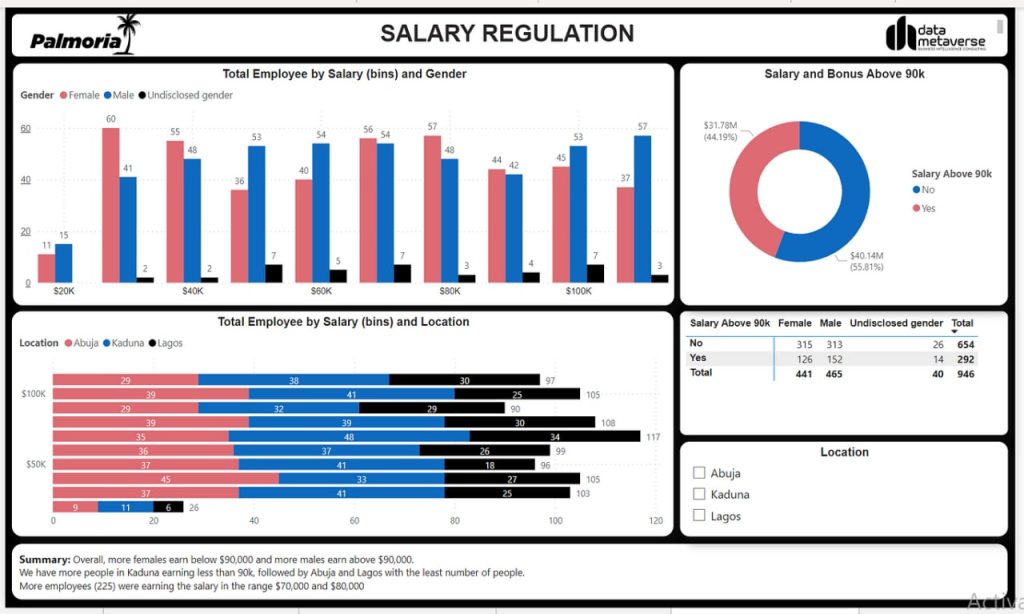
Palmoria also requests information about its degree of compliance with the $90,000 minimum wage requirement for the manufacturing sector.
Key Business Questions
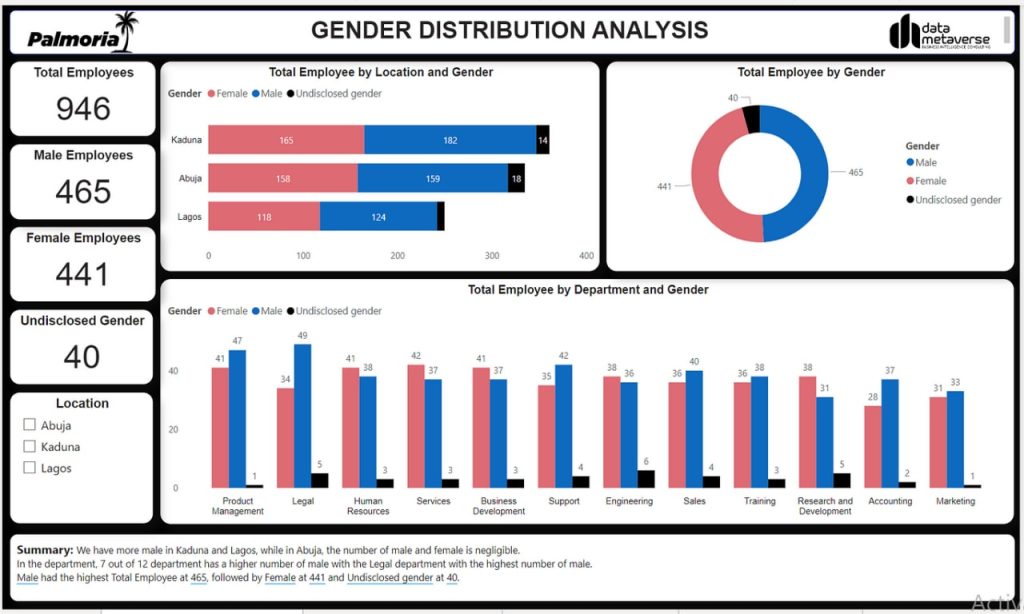
Are there more male than female or vice versa?
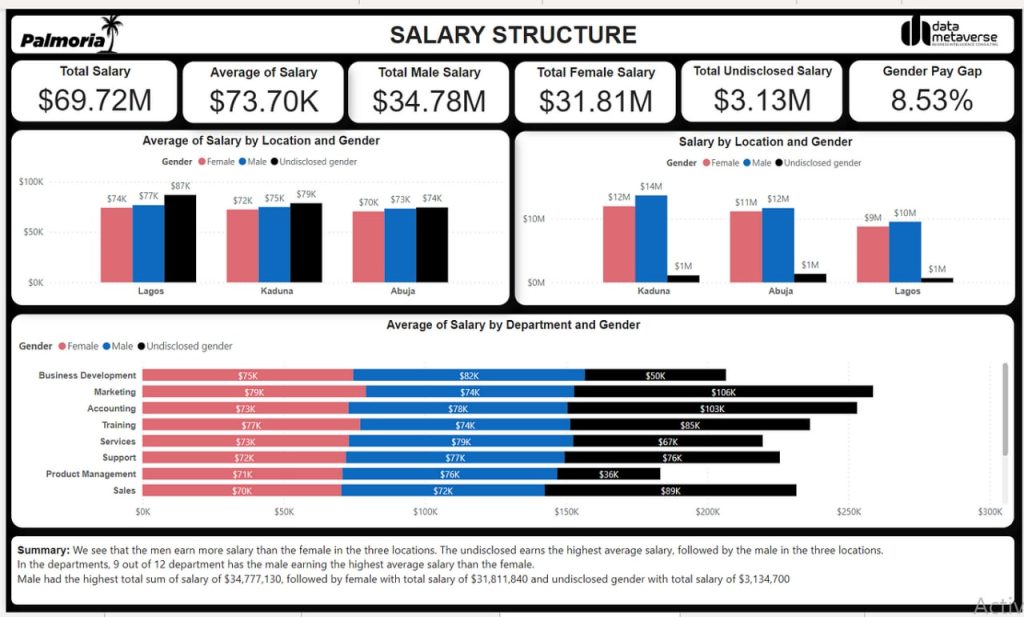
Is there a gender pay gap across the organization?
Do Palmoria meet the minimum wage requirement?
If they do not, how many employees do they pay rightly and how many is under paid?
How much more do they need to pay to level that gap?
Tasks
Determine if there is a gender disparity in the organization by analyzing the distribution of gender.
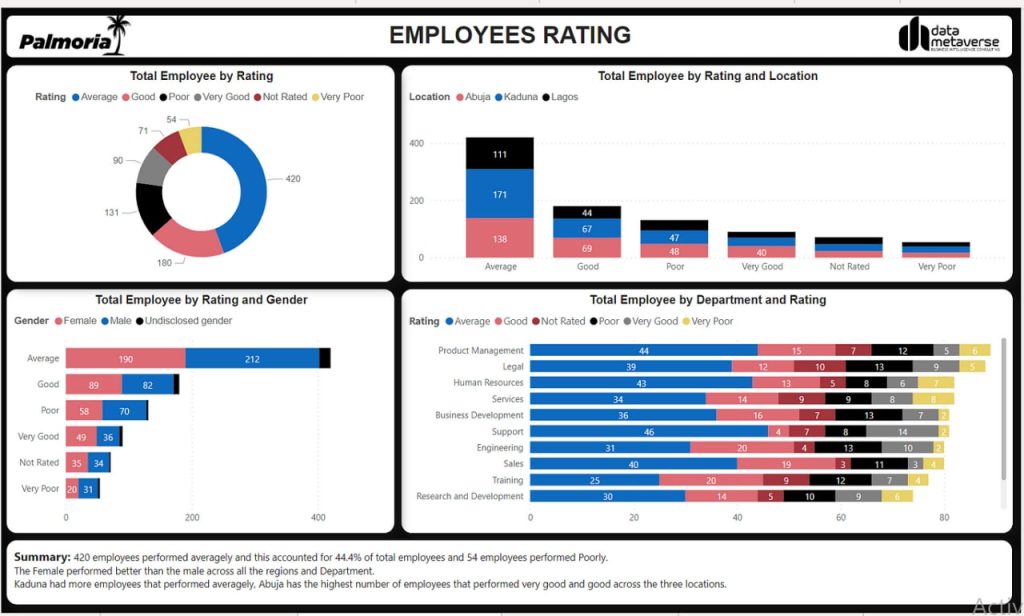
Examine the employee rating with a focus on the performance of women and men in various locations and departments.
Evaluate the company’s salary structure to see whether there is a gender pay discrepancy.
Analyze the degree of compliance with the minimum wage requirements in the manufacturing sector.
STEPS TAKEN
1. Defined the problem. 2. Collected the data. 3. Cleaned and modelled the data. 4. Visualized the data. 5. Analyzed the data.
Key Findings
Although there is a little gender gap in every location, it is most noticeable in the Lagos and Kaduna offices.
There is a modest gender wage discrepancy, favoring male employees in every location.
In the reviewed time, female employees performed better than their male counterpart.
Palmoria did not meet the minimum wage requirement for the manufacturing sector with an average total pay of $73,700
GENDER DISTRIBUTION
EMPLOYEES RATING
SALARY STRUCTURE
SALARY REGULATION
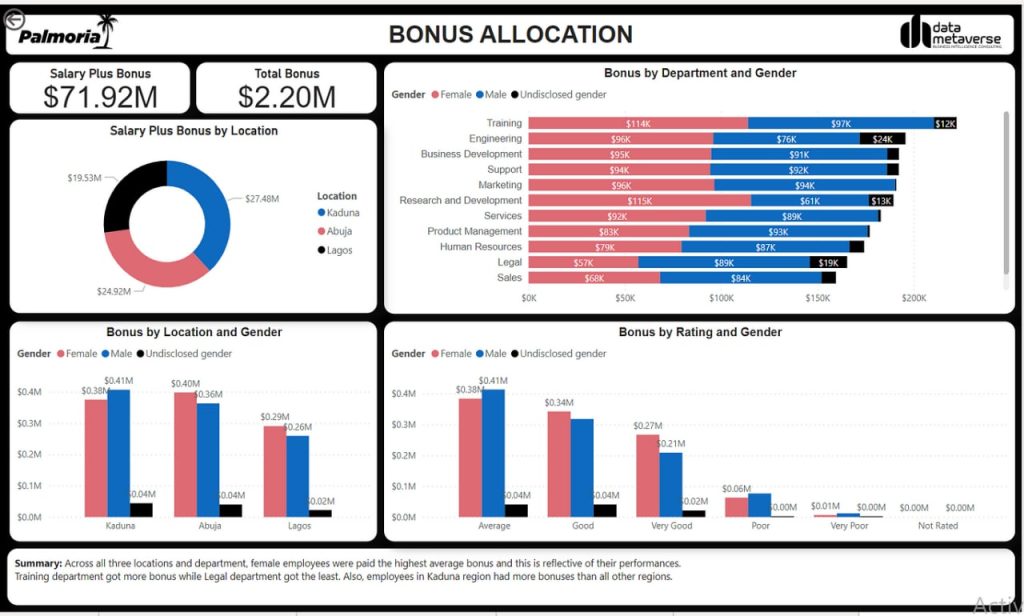
BONUS ALLOCATION
CONCLUSIONS
GENDER DISPARITY
There is a gender disparity throughout the organization, with a percentile ratio of 50.42% to 45.71% between male-female.
The Kaduna region has 17 more male than female, making it the region with the highest gender gap, followed by Lagos while Abuja is last.
Seven of the twelve departments led by the legal department, have slightly larger number of male employees therefore, it is considered that there is a negligible gender gap throughout the organization.
PERFOMANCE RATING AND BONUSES
Female employees performed better overall throughout the departments and regions which is reflected in higher overall bonuses.
The highest number of employees (420) performed averagely while a total of 54 employees performed poorly.
Abuja has the highest number of employees that performed very good and good across the three locations, on the other hand, Kaduna had more employees that performed averagely.
SALARY STRUCTURE
There is a gender pay gap in every region, with the male earning more than the female in all the regions. In all regions, male employees were seen to make considerably more money.
In nine out of the twelve departments, male employees received higher salaries on an average scale.
REGULATION COMPLIANCE
Palmoria has not met the minimum wage requirement of $90,000 according to the manufacturing regulation with 654 (69%) employees earning less than $90,000 with an average salary of $73,700
Even after bonus are taken into account, the net salaries of 654 (55.81%) employees still fall below the minimum wage requirement. The additional wage cost needed to close the pay gap for employees making less than $90,000 is at least $18.72 million.
RECOMMENDATION
Palmoria should revisiting its employment and salary policies in view of the pay gap in order to narrow the gaps that exist between the gender.
To comply with the minimum wage requirement, there is a need for an upward review of staff salary for employees in order to meet up with the $90,000 minimum wage.